
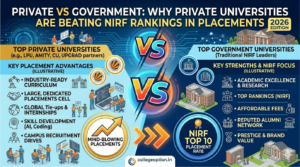
Every year during admission season, Indian households replay the same stressful script. A student misses a top-tier government cutoff by a razor-thin fraction, and the collective family mood drops. The long-standing societal narrative dictates that only elite government institutes guarantee a secure, high-paying career, while private universities are merely fallback options.
But the ground reality has completely shifted. While people remain fixated on static institutional rankings, forward-thinking private universities have quietly rewritten the campus placement playbook. They are systematically outperforming traditional government colleges where it matters most: delivering immediate corporate readiness and breaking international salary records.
The NIRF Illusion: Why Ranking Parameters Don’t Reflect Job Reality
The National Institutional Ranking Framework (NIRF) evaluates universities across five core parameters. While it offers a useful academic benchmark, a deep dive into its scoring methodology reveals why a high rank does not automatically translate to a better job offer.
| NIRF Scoring Weight | The Metric Focus | The Placement Reality |
| 30% | Teaching, Learning & Resources | Measures faculty ratios and financial allocations, not corporate networking. |
| 30% | Research and Professional Practice | Counts published papers and patents. Tech giants hire based on software building skills, not academic citations. |
| 20% | Graduation Outcomes | Tracks general graduation rates and basic median salaries with massive lag. |
| 10% | Outreach and Inclusivity | Focuses on regional diversity and gender balance metrics. |
| 10% | Perception | Measures academic peer reputation, which trails real-time market shifts by years. |
Because 60% of an institution’s NIRF score is tied directly to internal resources and academic research output, a legacy government college can easily maintain a top rank despite running an outdated tech curriculum and hosting stagnant placement cells. Private institutions, meanwhile, optimize their entire operational model around corporate agility and direct industry integration.
Breaking the Stigma: The Multi-Crore Placement Data
To truly understand how private universities are challenging old assumptions, look directly at the audited placement metrics from the latest recruitment cycles. Private ecosystems are no longer just inviting service-based mass recruiters; they are actively dominating elite domestic and international tech brackets.
1. Lovely Professional University (LPU): Shattering the CTC Ceiling
LPU’s recent placement cycles have completely dismantled the myth that historic packages belong exclusively to IIT campuses.
-
The International Spike: Sri Saravana Vishnu, a B.Tech Robotics & Automation student, secured a historic ₹2.5 Crore Per Annum (PA) international package.
-
Elite Volume: Over 2,236 students secured compensation packages of ₹10 Lakh and above, showcasing that high-value opportunities are distributed across a significant portion of the batch rather than being isolated anomalies.
-
Consistent Core Tractions: The top 10% of the graduating class achieved a highly competitive average package of ₹12.20 LPA, driven by direct partnerships with global giants like Microsoft, Amazon, Palo Alto Networks, and Google.
2. SRM University AP: Seamless Tech Integration
Similarly, SRM University AP (Amaravati) has built a dedicated pipeline into modern product firms, establishing a highly efficient corporate relations network.
-
Pure Technical Dominance: The institution recorded a 100% placement rate for its core B.Tech Computer Science Engineering (CSE) cohort.
-
Elite Placement Density: The highest domestic package reached ₹55 LPA, with a strong overall average package of ₹9.59 LPA across the board.
-
The Marquee Shift: Over 67% of the placed students secured offers exceeding ₹10 LPA, driven by an aggressive curriculum focus on agile development, machine learning, and cloud systems.
The Human Perspective: “I spent my entire class 12th believing that if I didn’t get into an NIT, my tech career was over,” says Rahul Sharma, an LPU CSE alumnus now working at an enterprise SaaS firm. “When I got here, I realized the corporate world doesn’t care about your college’s research ranking. They care if you can build scalable code under pressure. Private universities invest heavily in setting up that exact corporate environment from day one.”
Why Private Ecosystems Excel in the Modern Market
Private universities adapt to macro-economic changes and technological shifts at a pace that bureaucratic state or central institutions struggle to match. This responsiveness shows up across three main areas:
Active Curriculum Upgrades
When technologies like Generative AI or advanced robotics disrupt the corporate world, private universities can restructure their syllabi within a single semester. Government institutions often require multi-tiered board approvals that can take years, forcing students to learn legacy systems that the industry has already abandoned.
Massive Infrastructure and Innovation Labs
Whether it is specialized automation setups or high-compute development environments, private campuses channel capital directly into state-of-the-art infrastructure. Tech firms prefer recruiting from campuses where students are already accustomed to working on corporate-grade infrastructure.
Professional Finishing Schools
Securing a high-paying role requires more than just technical capability. Private universities build mandatory placement training modules directly into the weekly timetable. Students undergo intensive training in technical coding, mock corporate interviews, systematic resume building, and soft skills development led by seasoned industry consultants.
Smart Admissions: How to Maximize Your ROI
If you are looking to secure a high-value placement without getting bogged down by traditional admission bottlenecks, you need to use strategic application pathways. Private universities reward early intent and performance-driven candidates with significant financial waivers.
For students targeting elite placements at Lovely Professional University, you can completely bypass standard application cost barriers by using verified operational tracking codes.
Step-by-Step Registration Guide
The Verdict: Look at the Outcomes, Not the Stigma
The era of choosing a college purely based on its founding year or government status is over. In a hyper-competitive job market, your employment capability is defined by your actual skills, portfolio, and the corporate access your campus provides.
By delivering verified multi-crore placement peaks, high-volume double-digit average packages, and dynamic, modern learning ecosystems, leading private universities have proven they aren’t just alternatives to government colleges—they are setting the pace for the future of higher education.
Frequently Asked Questions (FAQs)
Q1: Why do private universities often beat top-ranked government colleges in campus placements?
A. While government colleges often rank higher on legacy NIRF metrics due to historic research papers and campus acreage, private universities hold a massive advantage in industry agility. Private institutions can completely overhaul their curriculum within a single semester to match tech shifts (like Generative AI and cloud computing), invest heavily in advanced infrastructure labs, and run mandatory corporate finishing schools that make students production-ready from day one.
Q2: What are the biggest flaws in using NIRF rankings to evaluate placement success?
A. The primary limitation is that 60% of the entire NIRF score is heavily weighted toward academic research output, faculty publications, and internal institutional resources. These factors measure academic theory rather than practical employability. Consequently, a traditional government college can easily maintain a high NIRF rank despite running an outdated tech curriculum and hosting stagnant corporate placement drives.
Q3: What was the highest package recorded by a private university student recently?
A. Shattering the myth that historic packages belong exclusively to IITs, Lovely Professional University (LPU) recorded an exceptional international package of ₹2.5 Crore Per Annum (PA), secured by a B.Tech Robotics & Automation student. Similarly, private institutions like SRM University AP have recorded maximum domestic packages scaling up to ₹55 LPA with high density in core product-engineering placements.
Q4: Are high placement numbers at private colleges limited to just a few top students?
A. Not anymore. While the absolute peak packages generate major headlines, the volume of high-paying jobs across the batch has grown significantly. For instance, across the recent graduating cohorts at LPU, over 2,236 students secured packages of ₹10 Lakh and above, and the top 10% of the class maintained a competitive average track record of ₹12.20 LPA. At SRM AP, over 67% of placed students converted offers higher than ₹10 LPA.
Q5: Is there an active discount code available for the 2026 LPU application form?
A. Yes. To avoid paying full price on the registration portal, applicants can use the verified partner scratch code LPUJAL394. Entering this code directly on the final payment summary page reduces the standard LPUNEST application form fee by flat 20% (dropping the cost from ₹1,000 down to ₹800).