
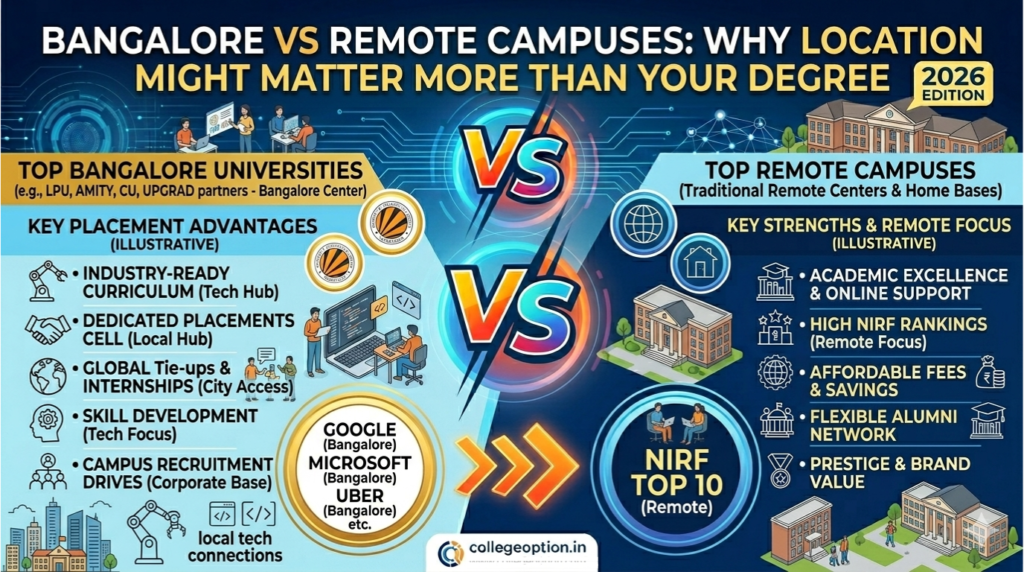
Imagine spending four grueling years memorizing theoretical algorithms in a picturesque, isolated college town. You graduate at the top of your class with an immaculate GPA, a pristine degree frame, and absolutely zero industry context. When you finally step into a job interview, you discover that the tech landscape moved two generations ahead while you were busy writing lab manuals.
For the modern tech and management student, the traditional college playbook is completely broken. As industries evolve at breakneck speeds, a critical truth has emerged: The geographical coordinates of your campus dictate your career trajectory far more than the brand name printed on your degree.
The Proximity Premium: Isolated Towns vs. Tech Capitals
When you study in a remote, Tier-2 or Tier-3 college township, your exposure to the corporate world is heavily restricted. You are trapped inside an “academic bubble” where industry interaction is limited to a single, hyper-crowded annual placement week.
Compare that to being physically positioned in Electronic City, Bangalore—the absolute epicenter of India’s Silicon Valley.
[Isolated College Town] ──> Stagnant Syllabus ──> Virtual Panels ──> Annual Mass Drive
[Electronic City Campus] ──> Real-time Pivots ──> In-Person Syncs ──> Continuous Networking
Living and learning in a tech capital changes everything. The engineers building the world’s most disruptive tools aren’t distant profiles on LinkedIn; they are ordering coffee at the same café as you. In Bangalore, networking isn’t a deliberate, high-effort task—it is the default ambient environment.
A physical presence in India’s primary tech hub fundamentally alters a student’s development:
-
Spontaneous Access: You can attend weekend hackathons, open-source meetups, and venture capital mixers without scheduling a cross-country trip.
-
The Velocity Advantage: When an enterprise tech firm or an AI startup pivots its architecture, the curriculum around you adapts instantly because your instructors are active industry builders.
-
High-Value Tractions: Instead of cold-emailing resumes into generic corporate HR portals, you are physically pitching your build to engineering managers who commute through the exact same tech parks.
Scaler School of Technology: Learning from Inside the Valley
If you want to capitalize on this geographic advantage, standard traditional campuses simply cannot deliver. This is why Scaler School of Technology (SST) intentionally built its fully residential urban campus right in the heart of Electronic City, Bangalore.
SST has completely replaced outdated classroom theory with a brutal, high-reward ecosystem structured around immediate industry immersion.
The Innovation Ecosystem in Numbers
| Institutional Track | Real-World Career Impact |
| ₹2 Lakhs / Month | The peak internship stipend cracked by SST students during their industry phase. |
| 96.3% Placement Density | The verified percentage of students locking in high-value, active corporate roles by their second year. |
| 15+ Founding Engineers | The volume of SST students who bypassed legacy entry roles to join Emergent AI—a hyper-growth startup currently operating at a $100M+ ARR. |
| Incubation Track | Deep-tech operations like NeoSapiens built directly inside the campus labs, securing capital on Shark Tank India. |
Instead of studying decades-old textbooks, students at Scaler spend their time building product ecosystems inside the Scaler Innovation Lab. The campus actively incubates student-led deep-tech projects, turning undergraduate builders into legitimate corporate founders while their peers at traditional universities are still studying for theoretical paper exams.
The Founder Perspective: “At a traditional engineering college, your absolute ceiling is usually a generic software engineer role at a service firm,” notes Ankit, an SST student developer. “Here in Electronic City, we are building systems alongside veterans from Meta, Microsoft, and Google. When our team built an AI-native wearable pendant, we didn’t just submit it for a grade—we pitched it to institutional investors. You cannot replicate that kind of energy in a remote college town.”
Strategic Enrollment: How to Secure Your Seat at SST
Securing an intake slot at Scaler School of Technology requires clearing the Scaler National Scholarship and Entrance Test (NSET), followed by a rigorous interview cycle. Because the cohort is limited to top-tier algorithmic builders, optimizing your registration process early is vital.
If you are locking in your application for the upcoming intake cycle, you can bypass standard fee structures using verified institutional partner codes.
Step-by-Step Registration Guide
1.Access the Portal:Step 1.
Head over to the official Scaler School of Technology application portal and complete your basic educational profile.
2.Apply the Active Partner Coupon:Step 2.
Before proceeding to the test allocation window, navigate to the billing panel. Use the exclusive coupon code EXAM500 or OPTION50 to instantly activate your application fee waiver.
3.Schedule and Clear the NSET:Step 3.
Book your Scaler NSET entrance slot. Focus your preparation heavily on core logical reasoning and mathematics, as the exam skips archaic physics/chemistry testing.
4.Complete the Interview Stage:Step 4.
Sit for the mandatory personal evaluation interview with industry experts to secure your final admission offer and institutional scholarship bracket.
Frequently Asked Questions (FAQs)
Q1: Why does location matter more than the college brand name for tech careers?
A. Tech innovation moves incredibly fast. While a remote university might have a historic brand name, it lacks immediate access to real-time corporate shifts. A campus located directly inside a tech capital like Bangalore allows students to participate in local developer ecosystems, secure continuous internships, and build face-to-face relationships with founders and engineering leads.
Q2: What kind of practical outcomes do students achieve at Scaler School of Technology?
A. SST operates an intensive industry-immersion model. By their second year, 96.3% of eligible students secure active internships, with top stipends reaching ₹2 Lakhs per month. Additionally, over 15 students have joined premier AI startups like Emergent AI as founding engineers right from day zero.
Q3: How does the Scaler Innovation Lab differ from traditional college computer labs?
A, Traditional labs focus on static, academic assignments to pass university exams. The Scaler Innovation Lab is a deep-tech accelerator where students build scalable, market-ready products. Projects incubated here have gone on to win massive national grants (like Samsung’s Solve for Tomorrow) and secure funding on Shark Tank India.
Q4: Are there active discount codes available for the Scaler application form?
A. Yes. When registering for the entrance exam on the official portal, prospective students can use the authorized codes EXAM500 or OPTION50 within the payment section to activate promotional application benefits.